
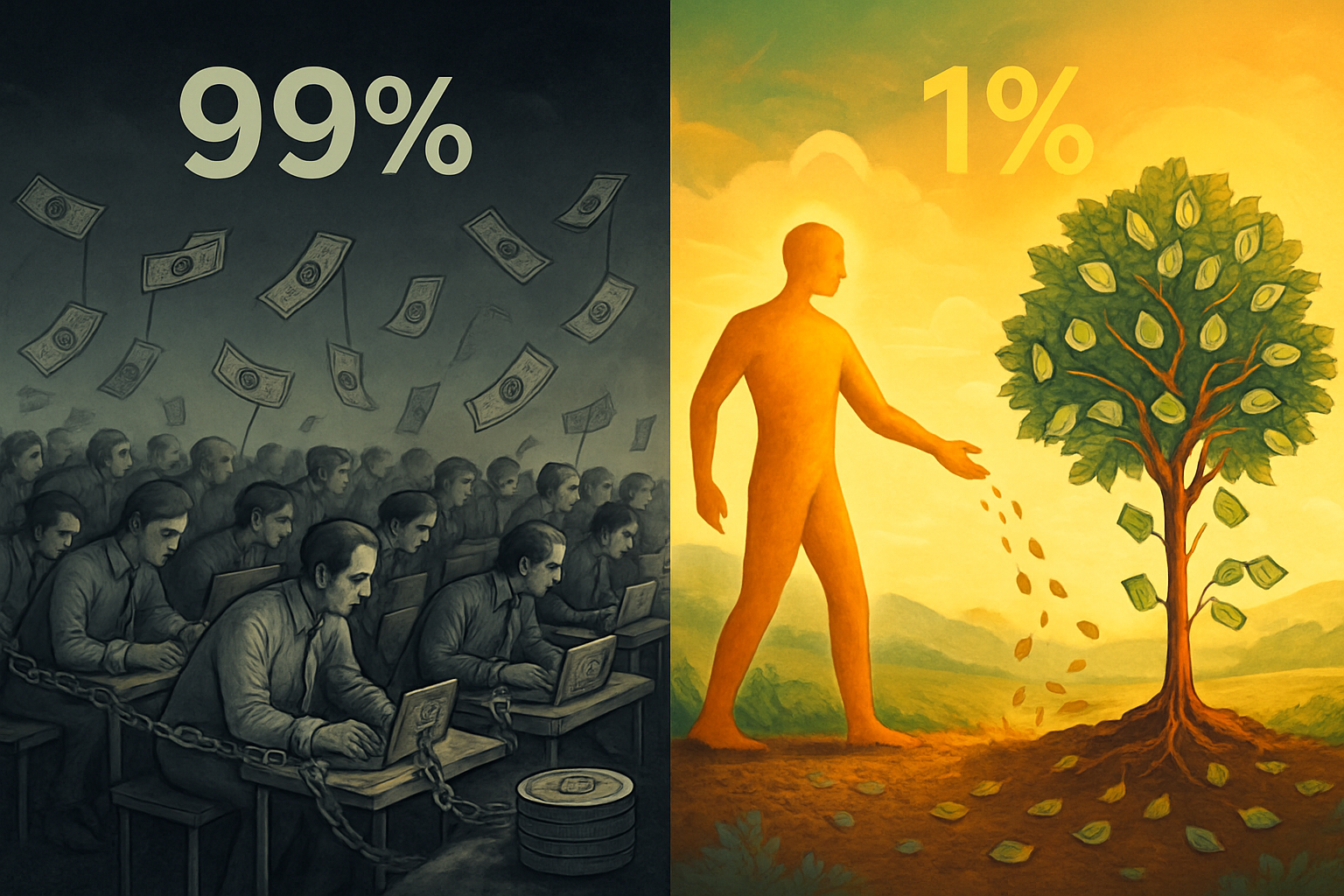
Mindset is the key that decides everything about your life and your future.
"If you give a lot of money to an always-broke person and leave for a year, you will find that person broke again when you return. In the same way, if you take everything away from an always-rich elite person and leave for a year, you will find that person rich again when you return."
- SM Rafi
It is not luck, resources, chance, or environment that works — it is only 'Mindset'. Both persons have almost same number of hands, legs, heart, eyes, brain but one is a builder and other is a destroyer!
We can classify the entire population of the world into two groups: the 99% and the 1%.
You cannot deny that the elite 1% hold 99% of the entire wealth, while the remaining 99% of people struggle to live their lives with just 1% of the money.
This is not luck, but one thing and one thing only — the mindset.
Here are a few differences between the mindsets of these two groups:
1. Gratification: 1% accept delayed rewards, seed sown won't give fruit instantly. 99% want instant results, otherwise they won't put even a bit of their effort.
2. Patience: 1% stay consistent even when nothing happens for a long time. 99% quit if progress is slow.
3. View of Money: 1% see money as a tool, but they value people. 99% see money as an ultimate medium of survival and try to use people.
4. Work Model and Time Leverage: 1% build systems that work without their involvement, they automate it with teams and tools. 99% trade time directly for money, they rely mostly on personal effort. This is one of the reasons why they have just 1% of money and struggle thier entire life - when it is limited to 24 hours a day, how can one trade it for 99% of money?
5. Survival vs Growth: 1% work for growth, wealth, freedom. 99% struggle for survival yet they stay in their 'comfort zone' - this is also a reason for why they have only 1% of money. money loves speed, consistancy and action, why a person in their comfort zone will build these requirements?
6. Purpose of Education: 1% learn to understand and apply, use in the real life for success. They keep learning continuously, keep themselves updated and squeeze out opportunities. 99% gain education only to obtain grades, compete, and to qualify for jobs. Then they stop learning and think they know everything.
7. Risk Perception: 1% take calculated risks, investigate before investing and monitor consistently. They respect compounding and time. 99% avoid risk and choose comfort. But if we insist them to invest, they often fall for 'get rich quick' scams but they don't understand the term 'gradual growth'!
8. Security Belief: 1% know that no income source in the world is truly “secure”, so they build multiple ways of creating wealth. 99% believe jobs equal security.
9. Problem View: 1% look at problems as opportunity to open a new wealth source. 99% avoid problems, they are ready to carry them on their heads but won't try towards a solution.
10. Opportunity Recognition: 1% notice gaps and inefficiencies to find out new opportunity. 99% wait for instructions or openings.
11. Money Behavior: 1% use money to invest in assets, businesses, systems. 99% work continuously for money and spend wrongly.
12. Luxury: for 1%, luxury is not only a need, a lifestyle but a deal because they make wealth by using luxury. 99% do buy luxury which they don't need, with the money they don't own (loans / emi's), to impress the people whom they don't like!
13. Creation vs Consumption: 1% create more than they consume, they are the 'producers'. 99% consume more than they create, hence they become 'consumer'.
14. Thinking Horizon: 1% think and visualize for years or decades. 99% think for days, weeks or months.
15. Growth Focus: 1% aim for expansion and scalability. 99% aim for survival and stability.
16. Ego vs Curiosity: 1% admit they don’t know everything and love to learn new things. 99% defend what they already believe, they think they don't need to learn anything more.
17. Feedback Handling: 1% use failure as feedback, they build their system more robust from it. 99% take failure personally and as a reason to stop working.
18. Responsibility: 1% take full responsibility for outcomes, especially the negative ones, and try to give credit for positives ones to others, to encourage their teams. 99% blame environment, people, or luck, its that simple for them!
19. Decision Speed: 1% decide, test, and adjust, they believe 'DKSK' - "decide karo side karo'. 99% overthink and either delay or abort the action.
20. Comfort Zone: 1% tolerate discomfort for growth, they keep patience. 99% prioritize comfort, just like a drug addict do for drugs. In return they are ready to forget success.
21. Value Creation: 1% focus on creating value for many others. 99% focus on earning income for themselves.
22. Scarcity vs Abundance: 1% believe value can expand. 99% believe opportunity is limited.
23. Ownership: 1% prefer ownership and control. They even achieve. 99% prefer instructions and certainty (slavery mindset).
24. Attention: 1% build, protect attention and focus. 99% leak attention through distraction.
25. Time value: 1% value time, their own's and of others. 99% show off as if they don't have time but do spend hours on netflix, social media or gossiping about other people, celebrities who aren't going to give them a damn!
There are many more differences, but the ultimate truth remains the same: wealth isn’t luck, inheritance, or genius IQ — it is thought patterns.
To be honest, transforming your thinking from one class to another is not easy. But if you truly want to win, start thinking like the 1%. Change the way you see the world. Change is not a thing to avoid — it is an opportunity. Embrace it. Start training your mind to be a 'producer' but not a 'consumer'. Focus on the positive side without neglecting the negative. Past is passed, lets focus and put energy on the present to build the future!
Hard? Yes. Too hard? Maybe. Worth it? Absolutely.
Frequently Asked Questions:
1. Is it really possible to change a 99% mindset if you were raised in a survival environment?
- Yes, but it isn’t an overnight "realization". A good mentor may help you stay focussed on the goal. From an engineering standpoint, you are essentially rewriting your decision-making algorithms. It starts with small, consistent changes—like choosing to save 10% of your income before spending—until the new logic becomes your default setting.
2. Why do you say "security" is a trap for growth?
- Security usually implies a fixed, predictable outcome in exchange for a fixed, predictable effort. While this is comfortable, it caps your potential. Growth requires "controlled volatility"—the willingness to trade immediate certainty for a system that can scale.
3. What is the first practical step to move from "Trading Time" to "Building Systems"?
- The first step is documentation. You cannot automate or delegate what you haven't defined. Start by tracking how you spend every hour for one week. Identify tasks that are repetitive and low-value, then create a simple "Standard Operating Procedure" (SOP) to eventually hand that task over to a tool or a team member.
4. Can a small business owner in India really use AI and automation without a huge budget?
- Absolutely. In 2026, the cost of "Digital Workers" (AI tools) has dropped significantly. The constraint for most Indian SMEs isn't the cost of the software; it’s the lack of structured processes. If your manual process is messy, automating it just creates "automated mess". You can take help of MyCityBiz.com to fix the logic and use low-cost tools to scale it.
5. How do I differentiate between a "Calculated Risk" and a "Gamble"?
- A gamble is a decision made on hope with no control over the variables. A calculated risk is a decision where you have researched the failure points and have a "margin of safety." If the worst-case scenario doesn't wipe you out, and the upside is scalable, it’s a calculated risk.
6. Why is "Delayed Gratification" so central to wealth creation?
- It is the principle of compounding. If you consume your "seed" today, you lose the entire future forest that seed could have grown. Builders view money as "potential energy"—the longer you let it sit and work in a system, the more powerful it becomes.
7. Does the "1% Mindset" mean I have to stop enjoying life?
- On the contrary, it means you enjoy life more because your freedom isn't tied to your daily labor. The "1%" don't avoid luxury; they avoid paying for luxury with their active time or high-interest debt. They wait until their assets can fund their lifestyle.



💬 Comments
Leave a Comment